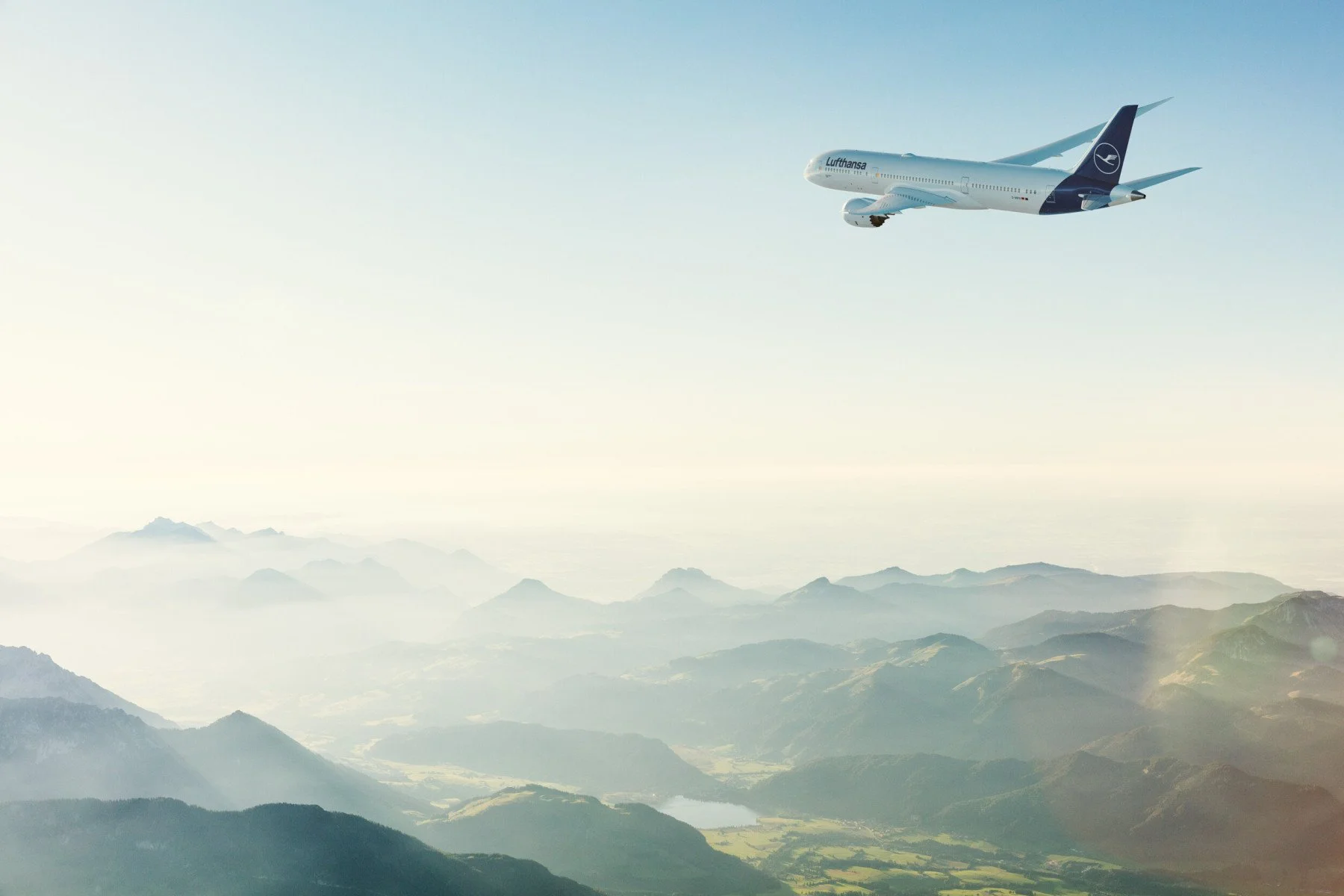
Lufthansa Group has renamed its Green Fare as Impact Fare, reflecting new regulations governing environmental claims while continuing to offer passengers the opportunity to support the use of sustainable aviation fuel and climate protection projects when booking flights.
For UK business travellers and the organisations responsible for their travel arrangements, the change highlights an increasingly important consideration in business travel: understanding exactly what airlines mean by sustainability claims, how environmental contributions are calculated and what benefits are included in the fares they purchase.
The new name is intended to make the purpose of the fare clearer, emphasising the contribution passengers make towards environmental initiatives rather than suggesting that their individual flight has no environmental impact. However, this is a change of name rather than the introduction of an entirely new product. The underlying approach remains the same, with contributions towards sustainable aviation fuel (SAF) and selected climate protection projects included within the ticket price.
How Lufthansa's Impact Fare works
The Impact Fare combines two approaches to addressing the environmental impact of flying: supporting additional SAF use within Lufthansa Group's operations and contributing towards climate protection projects outside the airline group's own activities. The balance between these two elements depends on the type of journey.
For flights within Europe, the fare includes a contribution towards additional SAF based on 20% of the estimated flight-related CO₂ emissions. The remaining 80% forms the basis of a contribution towards selected climate protection projects.
For intercontinental flights, the proportions change to 10% for SAF and 90% for climate protection projects.
Lufthansa Group confirms that the additional SAF associated with each Impact Fare booking is deployed within its flight operations within six months of the passenger's departure.
This does not necessarily mean that the aircraft carrying the passenger will use the additional SAF purchased through the scheme. Instead, the fuel is introduced elsewhere within the airline group's network.
The climate protection projects supported by the fare are designed to avoid or remove CO₂ emissions, depending on the particular project.
This distinction is important. Although these contributions support environmental initiatives, they should not be interpreted as eliminating the emissions produced by an individual flight.
What does this mean for business travel?
For businesses seeking to understand and manage the environmental impact of employee travel, the Impact Fare provides an additional option when selecting flights.
Rather than arranging a separate environmental contribution after booking, travellers can choose a fare that already incorporates support for SAF and climate protection projects.
The fare is available across Lufthansa Group airlines in all travel classes, making it relevant to employees travelling in Economy, Premium Economy, Business Class or First Class, where those cabins are offered.
There are also practical travel benefits. Passengers booking Impact Fares receive additional Miles and Points through the airline group's loyalty programme. Depending on the booking class and destination, the fare may also include more flexible rebooking conditions or changes without additional fees. These features can be particularly useful for business travellers whose meeting schedules, appointments or travel requirements change at short notice. However, companies should consider the total cost of the fare, the flexibility included and their own travel policies before deciding whether an Impact Fare represents the most appropriate choice.
Paul Baker, Sales Director at Global Travel Management, commented:
"For business travellers, the important thing is understanding what they're actually paying for. If a fare includes a contribution towards sustainable aviation fuel or environmental projects, that's useful information, but it needs to be explained clearly and accurately.
Companies are increasingly looking at the environmental impact of their business travel, alongside cost, convenience and flexibility. Having more choice is welcome, particularly when the benefits and limitations of those choices are transparent."
Why has Lufthansa changed the name?
The decision reflects a wider shift in how airlines and other businesses communicate their environmental credentials.
Regulators have become increasingly concerned about the use of terms such as 'green', 'carbon neutral' and 'environmentally friendly' where those descriptions could give consumers a misleading impression of a product's environmental impact.
The European Union has introduced stronger rules governing environmental marketing claims, with greater emphasis on clear, substantiated information.
Lufthansa Group's decision to replace Green Fare with Impact Fare reflects this changing regulatory environment.
The new terminology focuses attention on the contribution made through the fare, rather than implying that flying itself becomes environmentally harmless.
This is particularly relevant to corporate travel programmes, where sustainability reporting, supplier selection and environmental claims are increasingly subject to scrutiny.
For organisations operating internationally, it also reinforces the importance of distinguishing between measures that directly reduce emissions and financial contributions supporting environmental initiatives elsewhere.
More than five million passengers have already chosen the fare
Lufthansa Group introduced its Green Fare in 2023, initially offering passengers a way to incorporate environmental contributions directly into their flight bookings. Since then, more than five million passengers have selected the fare, demonstrating substantial interest in options that support environmental initiatives.
The airline group has progressively expanded the offering, making it available across different routes and travel classes.
Alongside the Impact Fare, Lufthansa Group says its wider approach to lower-emission aviation concentrates on five areas: modernising its aircraft fleet, improving fuel efficiency, increasing the use of SAF, developing connections between different forms of transport and offering environmental contribution options to private and corporate customers.
The group has also participated in global climate and weather research for more than 30 years.
Understanding sustainable aviation fuel
Sustainable aviation fuel is produced using alternative feedstocks and processes rather than relying exclusively on conventional fossil-based aviation fuel. Depending on how it is produced, SAF can deliver lower lifecycle greenhouse gas emissions than conventional jet fuel. However, SAF is not emissions-free. Aircraft burning SAF still release CO₂ into the atmosphere, and the overall environmental benefit depends on factors including the feedstock, production method and supply chain.
SAF also remains significantly more expensive than conventional aviation fuel, and global production is still relatively limited. Consequently, schemes such as Lufthansa's Impact Fare offer passengers and businesses a way to help support additional SAF demand, rather than guaranteeing that an individual journey will operate entirely on alternative fuel.
A wider change in how business travel approaches sustainability
Lufthansa's decision to adopt the term Impact Fare reflects a broader development across the travel industry. Increasingly, the emphasis is shifting away from broad environmental promises towards measurable actions, clearer explanations and more transparent reporting.
For businesses, this makes it important to understand the difference between measuring travel-related emissions, taking steps to reduce them and contributing towards initiatives that support wider environmental objectives.
Global Travel Management takes a similarly transparent approach through its Climate Contribution Programme, which helps businesses understand the environmental impact of their travel and take informed action.
Built around the principles of Measure. Understand. Reduce. Contribute., the programme encourages organisations to assess their business travel emissions, identify opportunities to reduce their impact and make meaningful contributions towards environmental initiatives.
The distinction matters because purchasing a contribution does not remove the emissions associated with a journey. However, it can form part of a wider, considered approach to responsible business travel.
For UK companies balancing the need to travel with their environmental commitments, greater transparency from airlines is a welcome development.
Lufthansa's change of terminology may appear relatively minor, but it reflects an important shift towards describing environmental initiatives more precisely and helping travellers understand the choices available to them.
For further information about Lufthansa Group's Impact Fares, sustainable aviation fuel or how Global Travel Management can help your organisation manage the environmental impact of business travel, please contact your Global Travel Management Account Manager.