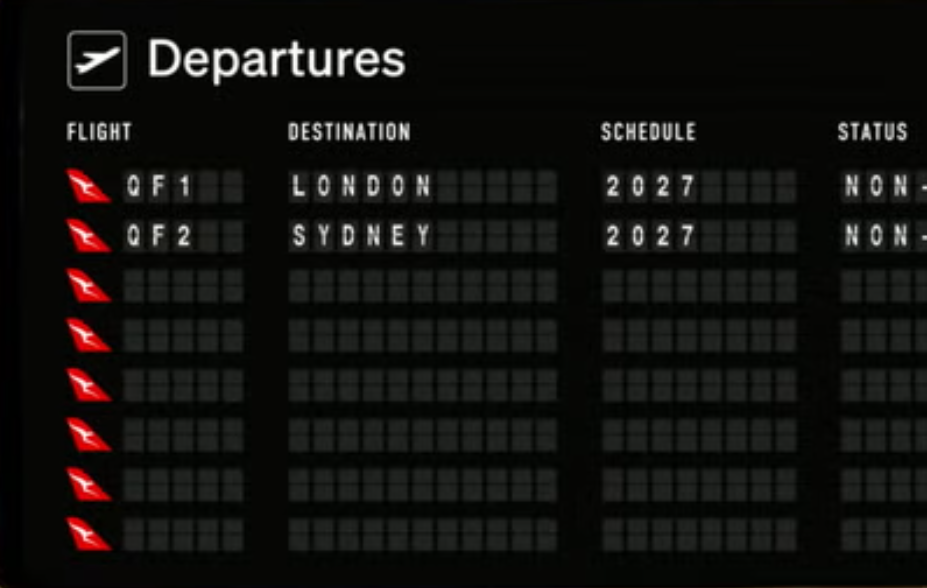
Qantas has confirmed that its iconic QF1 and QF2 flight numbers will be used for new non-stop services between London and Sydney from October 2027, with tickets expected to go on sale in February. The flights could cut up to four hours from the journey, but for business travellers, there's an interesting question: is spending more than 20 hours on one aircraft really preferable to breaking the journey?
Four days. Seven stops. That's what it took to fly between Sydney and London when Qantas launched its famous Kangaroo Route in 1947. Eighty years later, the Australian airline is preparing to make the same journey without stopping once.
Qantas has confirmed that its flagship QF1 and QF2 flight numbers will be transferred to the new non-stop London–Sydney services, scheduled to begin in October 2027 as part of its ambitious Project Sunrise programme.
Tickets are expected to go on sale in February 2027, although final schedules and fares have yet to be announced.
For UK business travellers, it promises a remarkable improvement in connectivity with Australia. But while the time savings are undoubtedly attractive, the prospect of spending more than 20 hours in the air raises some interesting questions about comfort, fatigue and productivity.
A journey that once took four days
The original Kangaroo Route was an adventure in itself. Passengers travelling between Australia and Britain stopped in Darwin, Singapore, Calcutta, Karachi, Cairo, Castel Benito and Rome before finally reaching London. Today, the journey typically involves a single stop, often in Singapore or the Middle East.
Qantas already operates non-stop flights between London and Perth, introduced in 2018, but connecting London directly with Sydney represents a considerably greater challenge. The new service is expected to save passengers up to four hours compared with existing one-stop journeys.
For someone travelling to Australia for an important meeting, an international conference or a series of customer visits, those hours could make a genuine difference. But will they necessarily make the journey better?
Twenty-two hours of endurance – and a new approach to comfort
To operate the service, Qantas has ordered specially configured Airbus A350-1000ULR aircraft, designed for flights lasting up to 22 hours.
Rather than filling the aircraft with as many passengers as possible, Qantas has opted for just 238 seats across four cabins. The configuration includes six First suites, 52 Business suites, 40 Premium Economy seats and 140 Economy seats, including 42 Economy Plus seats.
Business Class passengers will have private suites with doors, direct aisle access and fully flat beds, while First Class will offer separate beds and reclining chairs. Perhaps more interestingly, the aircraft will feature a dedicated Wellbeing Zone, accessible to passengers in every cabin.
This area will provide space for stretching and movement, hydration facilities and guided exercises designed to help passengers cope with the physical demands of an exceptionally long flight.
Qantas has also worked with researchers at the University of Sydney's Charles Perkins Centre to explore how cabin lighting, meal timing, sleep and movement might help passengers manage ultra-long-haul journeys. It's a recognition that flying for more than 20 hours isn't simply a matter of having enough fuel in the tanks. The people on board need to arrive in reasonable shape, too.
Is the fastest journey always the best journey?
For business travellers, the appeal of flying non-stop is obvious. There are no connections to miss, no airport transfers, no waiting around for the next departure and fewer opportunities for checked baggage to go astray. Saving several hours could also mean arriving in time for an additional meeting, spending another evening at home or simply reducing the amount of time lost to travelling.
But there's another side to the argument. Twenty hours or more in an aircraft seat is an extraordinarily long time, even in a premium cabin. Some travellers will welcome the opportunity to settle in, sleep and reach their destination without interruption. Others may prefer to stretch their legs properly, enjoy a change of surroundings and break the journey in Singapore.
And while Qantas is investing heavily in passenger wellbeing, no amount of clever lighting or carefully timed meals can entirely remove the effects of crossing multiple time zones. The quickest itinerary on paper won't necessarily always be the one that leaves every traveller best prepared for work.
A new consideration for corporate travel policies
The arrival of Project Sunrise also presents some interesting decisions for employers and travel managers. Should companies automatically favour the shortest available journey, particularly when employees are travelling long distances for business? Or should traveller wellbeing, fatigue and the demands of the working schedule carry equal weight?
There's also the question of cost. Qantas has yet to publish fares for the new services, and it remains to be seen how the non-stop option will compare with existing one-stop alternatives. For companies managing significant travel expenditure, the difference could be important. A non-stop flight might justify a higher fare if it reduces time away from the office, eliminates an overnight stop or allows an employee to complete a business trip more efficiently.
Equally, a less expensive one-stop itinerary might be perfectly appropriate for someone with a more flexible schedule. The answer will depend on the individual traveller, the purpose of the journey and the company's travel policy. And that's precisely why having a choice matters.
Singapore isn't disappearing
Interestingly, Qantas isn't abandoning its established one-stop services via Singapore. Those flights will continue, but under the QF5 and QF6 flight numbers, leaving QF1 and QF2 for the new non-stop operation. That means travellers will be able to choose between the speed and convenience of flying directly to Sydney and the opportunity to break their journey.
For some, the decision will be straightforward. For others, particularly those travelling regularly between Britain and Australia, it may be worth considering the alternatives more carefully.
A new era for the Kangaroo Route
There's something undeniably impressive about the prospect of boarding an aircraft at Heathrow and stepping off in Sydney without having landed anywhere in between. What once took four days and seven stops will soon be possible in a single flight. It's an extraordinary achievement in aviation, and one that promises to bring Britain and Australia a little closer together.
But for business travellers, the most important development may not be the ability to fly non-stop. It may be the freedom to decide whether they actually want to.
Planning business travel to Australia? Global Travel Management helps businesses compare routes, fares and cabin options, balancing cost and convenience with the wellbeing of their travellers.
As Qantas prepares to launch its new London–Sydney services, our team will be following developments closely and helping customers understand the options available.