
Business travel in manufacturing is part of the operation – not just an expense
Manufacturing business travel is often treated as an administrative task or a line in the finance budget. But for many manufacturers, travel is closely connected to the day-to-day operation. It enables engineers to reach customer sites, helps sales teams develop relationships, allows specialists to support installations and keeps projects moving across multiple locations.
That makes manufacturing travel different from the more predictable travel patterns found in many office-based businesses. Employees may need to travel to customers, suppliers, factories, exhibitions, installations or remote project sites. Journeys may involve several destinations, specialist equipment, changing schedules and short-notice arrangements.
The scale of business travel also makes disruption significant. The Global Business Travel Association (GBTA) forecast that global business travel spending would reach $1.71 Trillion in 2026. While this figure covers all sectors rather than manufacturing alone, it illustrates that business travel remains a substantial organisational cost and operational activity.
The people travelling are also likely to have very different responsibilities. Sales teams may be visiting prospective customers, engineers may be responding to technical issues, project managers may be overseeing installations, quality specialists may be carrying out inspections and senior managers may be managing supplier or customer relationships.
When travel arrangements work well, these employees can focus on the purpose of their journey. When they do not, the consequences can extend well beyond inconvenience. Business travel contributes 3.5% of global GDP.
These figures do not prove that every journey produces a measurable operational return, but they do underline that business travel is connected to wider commercial activity rather than being merely an administrative cost.
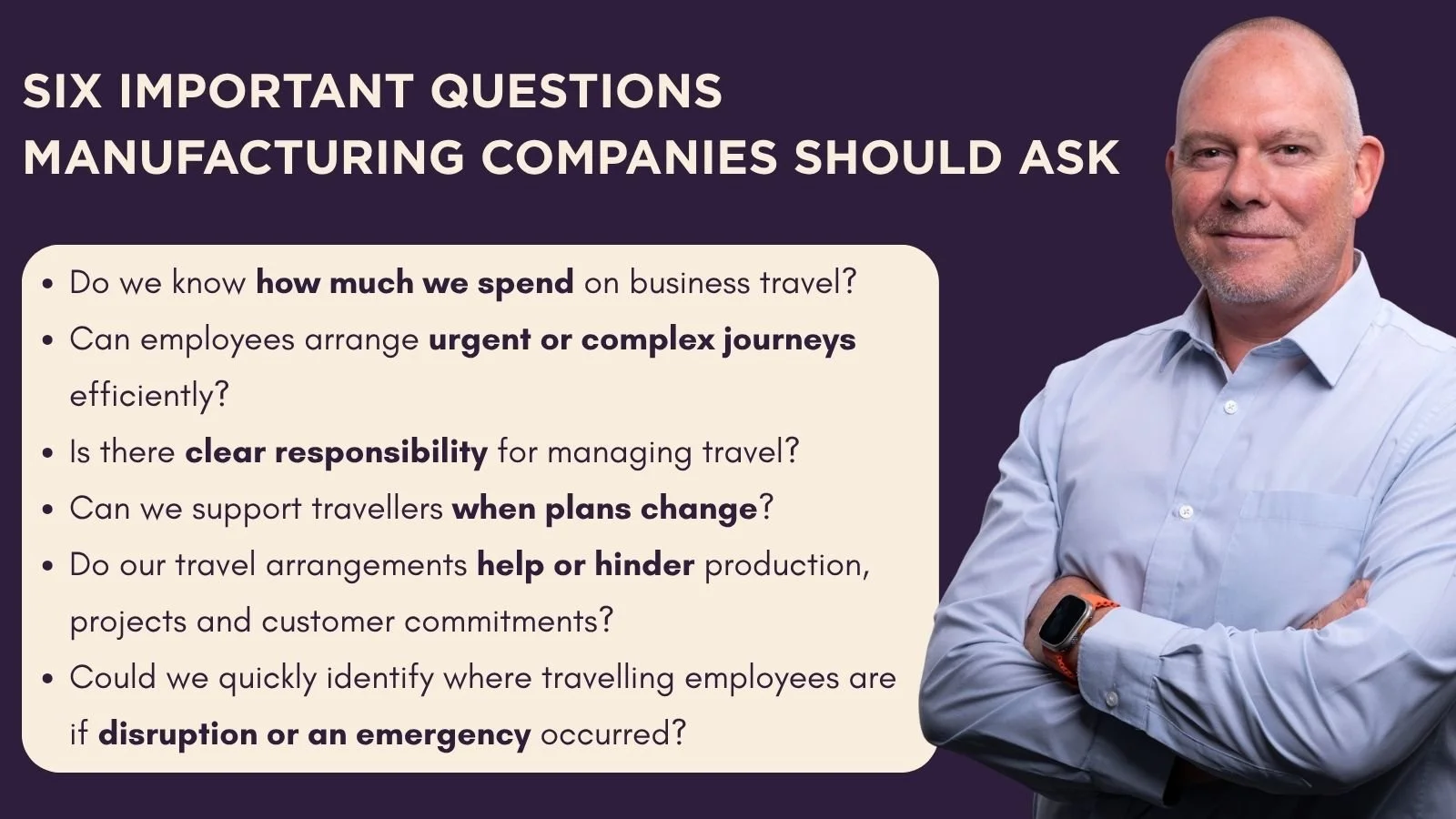
There are six questions any manufacturing business should ask itself to determine whether their business travel programme is operationally efficient
A delayed engineer may affect a production schedule. A missed installation deadline may damage a customer relationship. Poorly coordinated travel may create additional administration for project teams, finance departments and office managers.
Travel can also influence supplier performance and commercial activity. If employees cannot reach a factory, customer or supplier when needed, decisions may be delayed and problems may take longer to resolve. In a sector where timing, reliability and responsiveness matter, travel arrangements can have a direct effect on operational performance.
There is also a duty-of-care consideration. The International SOS Risk Outlook 2024 reported that 72% of risk professionals expected the complexity of managing travel risk to increase. For manufacturers sending employees to unfamiliar sites, remote locations or countries with changing security, health or transport conditions, knowing who is travelling and where they are can be an important part of supporting them.
This is why business travel should not be managed as a series of isolated bookings. A flight, hotel or rail journey may appear to be a simple transaction, but it forms part of a wider operational requirement. The booking needs to support the timing, location, purpose and priorities of the business.
A clear process is particularly important when travel is urgent, complex or involves multiple destinations. Employees need to know how to arrange travel, who is responsible for approving it and where to turn when plans change. The business also needs sufficient visibility to understand who is travelling, where they are going and how travel activity relates to wider operational objectives.
The cost of poor visibility can be difficult to quantify, but the administrative burden is real. In a 2023 survey of business travellers and travel managers, the GBTA Foundation found that travel managers spent an average of 12 hours per week on manual or administrative tasks, including booking support, reporting and policy-related work. For a manufacturing business without a dedicated travel team, those tasks may instead fall to office managers, project teams, finance staff or employees themselves.
This does not mean every journey needs to be controlled in the same way. Manufacturing businesses need arrangements that reflect the practical realities of their operations. An engineer responding to an urgent customer issue may need a different process from a team attending an exhibition several months in advance.
The important point is that travel arrangements should be aligned with operational priorities. Cost matters, but so do reliability, speed, traveller support, productivity, duty of care and the potential impact of disruption.
A useful starting point is to ask a few straightforward questions:
Do we know how much we spend on business travel?
Can employees arrange urgent or complex journeys efficiently?
Is there clear responsibility for managing travel?
Can we support travellers when plans change?
Do our travel arrangements help or hinder production, projects and customer commitments?
Could we quickly identify where travelling employees are if disruption or an emergency occurred?
The answers may reveal that the issue is not simply the price of individual bookings. There may also be opportunities to reduce administration, improve reporting, strengthen traveller support and make better use of travel information.
When travel supports production, projects and customer commitments, it deserves to be managed with the same care as any other operational resource.
The right arrangements can reduce unnecessary administration, improve visibility and help travelling employees focus on the work they are there to do.